


Eye diseases affect all age groups, both young and old, commonly. Children’s problems and strabismus, particularly strabismus (crossed eyes), are prevalent with various types and treatment methods. Today, we will learn about the most important eye diseases in children and delve into an explanation about children eye problems, their causes, and treatments, in line with the latest international treatment protocols from Dr. Ahmed El Moatasem Eye Care and Surgery Center.
Children’s Eye Problems and Strabismus
Children’s problems and strabismus are numerous and diverse, ranging from those affecting newborns to those appearing during the first months or years of a child’s life. Strabismus tops the list of the most common eye diseases in children. We will learn about this disease and others in detail in the following paragraphs, as well as explore treatment methods using the latest devices and technologies available at the Moatassem European eye center.
Pediatric Eye Diseases
Below are some common pediatric eye diseases with a brief description of each,
and it is important to note that any symptoms or signs of these diseases require immediate medical intervention.
• Strabismus
Strabismus is a well-known eye condition where there is an imbalance in visual alignment between the eyes,
resulting from refractive errors due to disorders in the eye or in the visual center in the brain,
or imbalance in the muscles responsible for eye movement control.
Strabismus is characterized by the child having direct and straight vision in one eye and Perverted vision in different directions in the other eye.
It can be treated with prescription glasses, or the child may recover spontaneously.
Strabismus affects approximately 4% of children and requires urgent treatment to prevent worsening of the condition reach to brain dysfunction, and inability to receive images and nerve signals coming from the eye to eliminate double vision, followed by amblyopia in 50% of children with strabismus.
• Myopia
Myopia it is a refractive vision problem, causes difficulty in seeing distant objects clearly in affected children and it’s one of the most combination Children’s problems and strabismus.
It is one of the most common eye Children’s problems and strabismus, with statistics showing that 9% of children aged 5 to 15 suffer from this condition.
It can be effectively managed with prescription glasses.
• Hyperopia
Hyperopia, or farsightedness, presents symptoms such as difficulty reading, lack of clarity in images in books, and other signs of difficulty with close objects.
Patients with hyperopia can see distant objects relatively clearly but struggle with closer objects.
The condition may improve with age spontaneously, and in some cases, therapeutic prescription glasses may be necessary.
• Childhood Astigmatism
The cornea is the clear layer at the front of the eye with a smooth curved surface.
In cases of pathological astigmatism, irregularities on the corneal surface affect visual quality, causing distortion in the refraction of light rays reaching the retina.
This results in blurred vision of both near and far objects.
• Lazy eye
Lazy eye refers to a difference in visual acuity between the eyes by 2 diopters or more.
Lazy eye leads to blurry vision in the future due to the inhibiting of visual signals in the brain and the prevention of clear images on the retina.
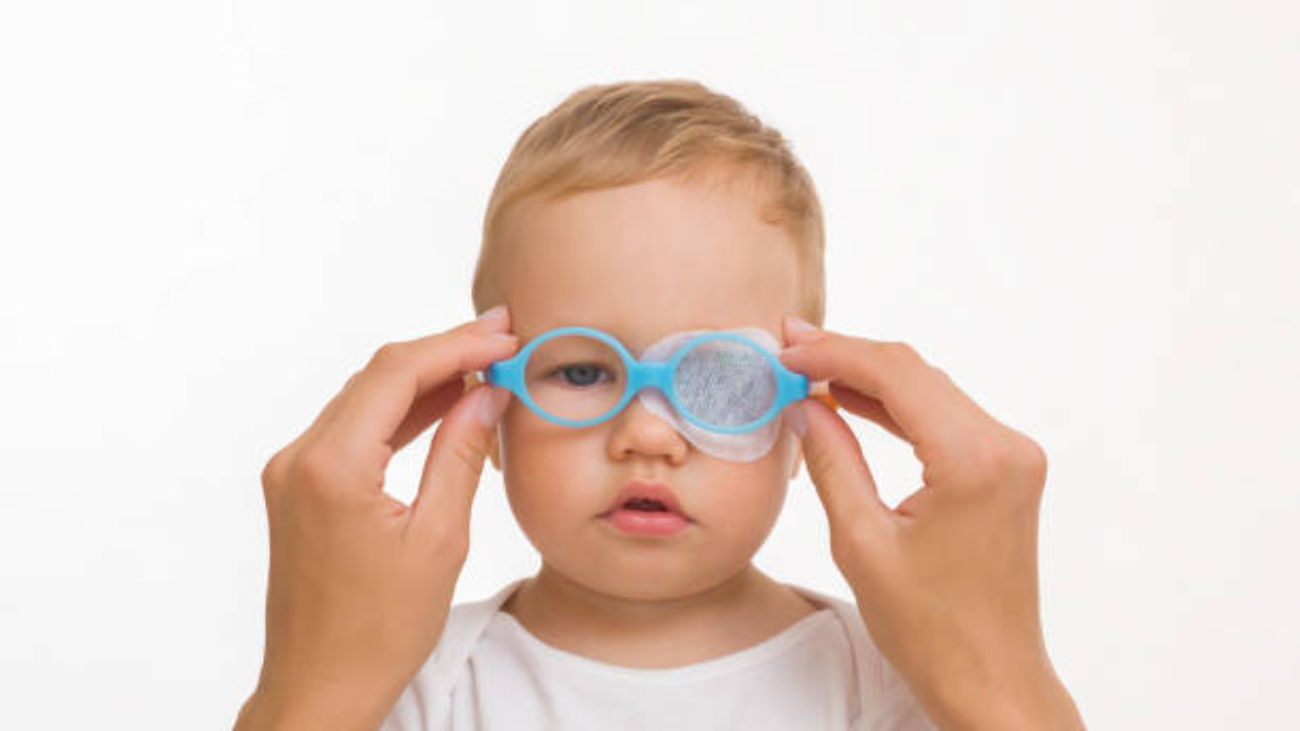
This condition is treated by applying an eye patch and covering the eye to promote reliance on the lazy eye.
• Blocked tear duct
A blocked tear duct is a congenital condition where the tear duct passage is obstructed by membranous tissues.
This condition is characterized by excessive tearing in the child and an increase in secretions at the inner corners of the eye.
Treatment for this condition includes topical drops and therapeutic massage before the child’s first year of age.
However, after the first year, the blockage usually resolves spontaneously, or the child may undergo a simple surgical procedure under general anesthesia to open the tear duct.
If this method is not successful, another technique called “balloon technique” is used to treat the blocked tear duct.
• Eye lid cysts
Eye lid cysts, also known as “chalazion”, are benign swelling in the eyelid of children resulting from the blockage of the Meibomian gland in the eyelid.
This condition is often treated with continuous massage; however, in some cases, inflammation in the eyelid may require topical treatment.
If the eye swelling becomes severe and persists for several weeks, surgical intervention may be necessary.
• Eye Rheum
Eye Rheum (eye dirt) is a common condition where fatty eye secretions accumulate in the corners of the eye or between the eyelashes. Eye discharge is particularly noticeable upon waking up in the morning and, in most cases, does not require any treatment as it usually resolves on its own.
Special eye drops and ointments may be used if needed.
• Congenital cataracts
Congenital cataracts, also known as “infantile white cataracts,” are a pathological condition affecting newborns where their eye lens appears white, indicating this condition. Immediate treatment is required to prevent future lazy eye development. In most cases, congenital cataracts occur due to genetic reasons.
• Congenital glaucoma
Elevated eye pressure is not limited to the elderly, but also affects children and even newborns,
where the child experiences a range of symptoms including:
discomfort from bright lights, blurred vision, constant tearing,
deterioration of the Glucoma leading to the formation of a layer that obstructs vision,
in addition to a significant increase in the size of the eyeball.
• Retinoblastoma
One of the malignant cancerous eye tumors and Children’s problems and strabismus, where a reflection of a white color can be seen in the child’s eye pupil,
and it can only be diagnosed by an experienced eye doctor,
requiring direct treatment with laser therapy or partial/complete excision or with chemotherapy.
• Allergic conjunctivitis
Allergic conjunctivitis, also known as spring eye inflammation, occurs in spring and even in autumn,
sometimes seasonally due to the presence of pollen in the air,
or may be triggered by allergens such as certain flowers and foods.
Children with allergic conjunctivitis experience itching, redness, chronic blinking of the eyelids,
and burning sensation in the eyes when affected by this inflammation,
which can be treated with anti-inflammatory and antiallergic eye drops, and this condition usually continues until adolescence.
• Viral conjunctivitis
Viral conjunctivitis is a mild condition that affects the eye and typically resolves spontaneously within several days in most cases. This inflammation initially affects one eye, then the viral infection spreads to the other healthy eye, with symptoms including redness, tearing, and yellow or green purulent discharge from the eye.
Types of Strabismus in Children
There are several types of strabismus, each with specific symptoms and differences, including the following types:
• Esotropia:
Also known as “cross-eye strabismus”, in esotropia, one or both eyes turn inward continuously or intermittently.
It commonly affects children but can also occur in adults. Patients may experience double vision,
which can lead to more serious issues in children such as cognitive difficulties and problems with activities requiring coordination between the eyes and hands or feet.
• Exotropia:
Also called “divergent strabismus”, in exotropia, one or both eyes turn outward continuously or intermittently. This condition can occur across all age groups and is the opposite of esotropia. Symptoms may include double vision, difficulty concentrating, and the need for forced eye focus to improve vision.
• Hypertropia:
Also known as “vertical strabismus,” hypertropia is a severe and advanced form of eye misalignment where the eyes are not vertically aligned.
It can be classified as either symmetrical hypertropia if the fields of vision in both eyes are the same or asymmetrical hypertropia if the fields of vision are different.
This type results from abnormalities in the rectus, vertical, or oblique eye muscles.
• Hypotropia:
In contrast to hypertropia, hypotropia occurs when one eye turns downward compared to the other eye.
This can lead to perceptual difficulties and double vision and is caused by weakness in the muscles and nerves controlling eye movement.
• Children Strabismus: Accommodative/Non-Accommodative
Accommodative strabismus involves eye misalignment where the deviation angle is the same in all directions of vision,
with both eyes working well but deviating together at a single angle regardless of the viewing direction. Non-accommodative strabismus,
on the other hand, causes variable deviation angles depending on eye movement and viewing direction,
such as worsening when looking outward compared to inward.
• Children Strabismus: Intermittent/Constant
Strabismus can also be classified based on its appearance frequency in the eye.
Intermittent strabismus is irregularly occurring, with instances of disappearance and reappearance, while constant or stable strabismus results in permanent changes in the eye’s vision direction.
• Manifest/Latent Strabismus
Based on when strabismus is noticeable, manifest strabismus is visible when the eye is open and the child can fully see their surroundings.
Conversely, latent strabismus appears when the eye is closed or covered, while the other eye is open.
Sudden Strabismus in Children:
Strabismus can appear in children during the first few months or later stages of childhood,
with causes that include a variety of factors, such as:
- Genetic factors.
- Genetic disorders, as seen in children with Down syndrome.
- Premature birth in the sixth or seventh month of pregnancy.
- Cerebral palsy.
- Refractive errors in vision.
- Refractive eye diseases.
- Severe vision impairment in one eye.
- Weakness in the cranial nerves controlling eye movement.
- Head injuries.
- Brain inflammation and viral infections.
- Fracture of the eye socket bone.
Treatment of Strabismus in Children:
Treatment for strabismus in children varies depending on factors such as the child’s age,
the type of strabismus, progression of the condition, and other considerations.
Treatment options may include:
- Prescription glasses: The primary treatment option involves prescribing carefully measured glasses by the supervising doctor to correct vision. An eye patch may be recommended for one eye.
- Lazy eye treatment: When strabismus is due to lazy eye, the healthy eye is covered to force the lazy eye to work, correcting the condition.
- Vision exercises: In many cases, vision exercises can be beneficial for convergent strabismus, where the eye cannot align properly on a nearby object.
- Medications: When strabismus is organic, such as in disorders of the muscles controlling eye movement, medications can be prescribed to relieve muscle spasms.
- Surgery: When all previous treatment options fail, strabismus surgery may be necessary. This surgery aims to correct the surrounding eye muscles by tightening or weakening them to align the eyes simultaneously and align the visual axis. While this procedure is highly precise, its success rate is very high, especially at the Moatassem European eye center, where Dr. Ahmed and his team work to ensure the success of this procedure with the least possible complications and side effects, which are temporary minor discomfort and redness for a few hours.
Best Pediatric Ophthalmologist
Dr Ahmed El Moatasem is the best pediatric ophthalmologist in Dubai and the United Arab Emirates.
He is known for his deep medical expertise and kind demeanor towards both children and adults.
According to patient and parent experiences, the fear usually associated with eye doctors is non-existent at Al- Moatassem European eye center, as the entire medical and administrative staff work together to ensure the comfort, reassurance, and happiness of young patients.
It is worth mentioning that Professor Ahmed El Moatasem, a professor of ophthalmology at Ain Shams University,
always advises his future colleagues to treat pediatric patients with care and attention, as psychological safety is paramount in such cases.
His peers at the Royal College of Surgeons, the American Academy of Ophthalmology,
and the International Society of Refractive Surgery consistently praise Dr. Ahmed’s expertise in handling young patients and providing treatment in a compassionate manner.
This experience with children has only come after mastering medical and surgical skills and excelling in treating pediatric issues like strabismus, among others.
Best Center for Strabismus Treatment in Dubai and Sharjah
After understanding Children’s problems and strabismus, particularly strabismus,
it is important to highlight the best medical center for treating strabismus in the United Arab Emirates:
Moatassem European eye center. This center is unparalleled in its field, housing the best diagnostic and therapeutic medical equipment that relies on advanced and cutting-edge medical technology to treat strabismus definitively.
Additionally, accurate diagnosis of the type of strabismus is crucial, and the most skilled Arab ophthalmologists are found in this remarkable center, representing various specialties and countries. This team has come together to provide ideal healthcare that befits eye patients,
ensuring their safety. Starting from comprehensive examinations and integrated medical consultations, to precise diagnosis,
creating the most suitable treatment plan, and ending with strabismus treatment and regular patient monitoring.
Frequently Asked Questions:
• When does strabismus resolve in infants?
In most cases, the symptoms and signs of strabismus in infants disappear by the age of 6 months,
a condition referred to as pseudo strabismus.
However, if it persists beyond the first year of the child’s life, then it can be considered real strabismus and requires monitoring and treatment.
• What causes strabismus in one eye in children?
Strabismus in one eye is a result of a physiological condition in the affected eye,
which may be due to weakness in the muscle or nerve tissues surrounding the eye responsible for its movement.
• What are the common eye problems in newborns?
Congenital cataracts, strabismus, amblyopia, conjunctivitis, congenital glaucoma, nystagmus,
all of these conditions are independent medical conditions that can either resolve spontaneously or require medical intervention.
• When should strabismus be corrected in children?
According to Dr. Ahmed El Moatasem, the treatment stage for strabismus in children ranges from the seventh to the ninth year of age because a child’s final vision is typically achieved around the age of eight.
Medical consultation is necessary when advanced symptoms of strabismus are observed,
such as double vision, difficulty reading, or tilting the head to see objects.
• What are the reasons for closing of an eye in children?
Closing of an eye can occur in cases of lazy eye, where one eye is completely normal while the other is affected by a refractive error, leading to blurred vision.
Covering the healthy eye with a patch or bandage allows the affected eye to rely on its visual abilities and improve its condition.
Add a Comment