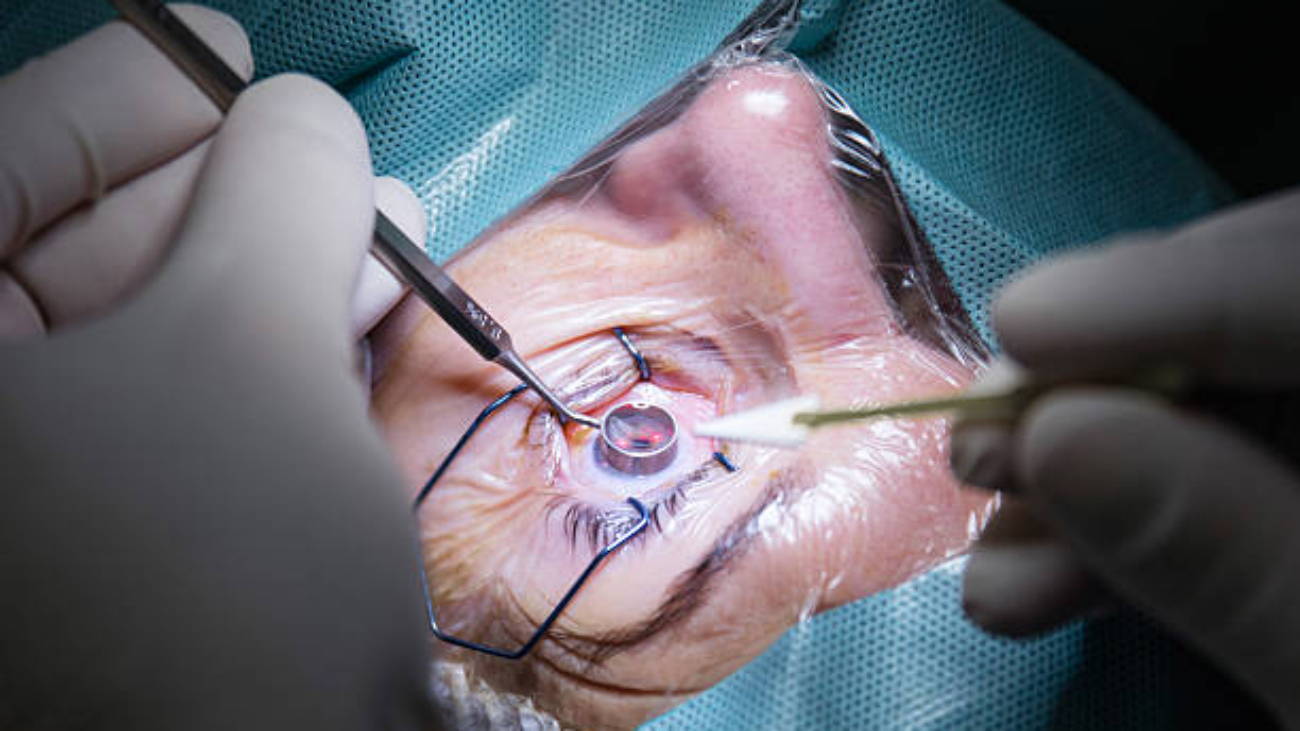

The most common eye disease among both the young and adults, the most widespread and easiest to treat, is keratoconus, in which the cornea degenerates to appear in a new shape different from its previous one, adversely affecting the quality of vision and life. Therefore, today we will explain the treatment mechanism for keratoconus at Moatassem European eye center, the best center for ophthalmology in the heart of Dubai and the United Arab Emirates. A definition of this condition, its causes, symptoms, and much valuable information await you. We will also conclude this article by answering the most frequently asked questions about this medical condition.
What is keratoconus?
Before discussing keratoconus, we need to understand the cornea of the eye,
which is a distinctive part of the eye characterized by an astonishing anatomical structure.
The cornea is located in front of the iris and is a curved dome made up of five layers, including two membranes. These layers consist of proteins, regular collagen fibers, and glycose.
They have high transparency across all their layers, do not contain any blood vessels,
and obtain the oxygen they need from the external air that touches them.
Therefore, it is positioned outside the eye and covers the front of the eye.
Its primary biological function is to gather incoming light rays into the eye and accurately project them through the regular collagen fibers onto the retina,
where they are converted into neural signals and sent to the brain.
Keratoconus, on the other hand, is a pathological condition characterized by the weakening of the collagen fibers that make up the layers of the cornea, leading to a change in its shape to a cone-like form. This results in a decrease in corneal thickness and a decline in visual quality due to the disruption in the transmission of light rays to the retina, following the change in the shape of the regular collagen scaffolding.
In some cases, keratoconus may be mild and treatable with corrective glasses,
or it may require a treatment procedure using the technique of corneal ring implantation,
which corrects its cone shape and restores its natural curvature.
However, in more advanced cases where no medical or surgical treatment can succeed, corneal transplantation becomes the definitive solution.
Symptoms of keratoconus
It should be noted that the symptoms of keratoconus in most cases become pronounced in the late stages of the condition,
where the state of keratoconus deteriorates and treatment with corrective glasses and simple procedures becomes unfeasible.
However, Dr. Ahmed El-Moatassem’s selection of the latest diagnostic devices and equipment in his center in Dubai
has alleviated these difficulties and made it possible to diagnose this condition at an early stage.
Of course, the initial diagnosis is significantly related to the experience of the ophthalmologist.
The common symptoms and signs include:
- Blurred vision.
- The need to constantly change the prescription of corrective eyewear if worn.
- A rapid decline in visual acuity.
- Difficulty in scrutinizing and reading.
- Headaches resulting from concentrating on objects.
- Scarring and scratches on the cornea in advanced stages.
Causes of keratoconus
Unfortunately, the causes of keratoconus remain unknown and mysterious to this day,
despite the well-known treatments for the condition.
There are no clear cases or factors that lead to the development of this eye disease.
However, based on the experiences of ophthalmologists and research statistics conducted over many years,
the likelihood of developing keratoconus increases among certain patients:
- Patients with a family history of keratoconus, especially among first-degree relatives.
- Cases where the patient frequently rubs their eyes, particularly in instances of seasonal allergies known as ‘Vernal ophthalmia,’ which can lead to itching and a burning sensation.
Treatment of keratoconus
The treatment of keratoconus in the UAE or any other Arab country is divided into several types,
depending on the treatment method and the patient’s condition.
The diagnosis of keratoconus is confirmed after following a series of diagnostic steps,
which include a comprehensive eye examination, measuring corneal thickness, and corneal topography.
Once the condition is confirmed, we proceed to the most appropriate treatment method.
We will provide a brief overview of each of these treatments in the following lines:
• Corrective Medical Lenses
Therapeutic lenses are the first solution in cases of primary keratoconus,
as they are utilized for early diagnosis of this condition. These lenses include several types, such as:
– Rigid Gas Permeable Contact Lenses
They are long-lasting contact lenses that consist of a porous structure and are therefore permeable to gases and vapors.
They are characterized by the fact that they do not take the shape of keratoconus, which is characterized by convexity,
but rather maintain a precise and therapeutic shape, unlike soft cosmetic or medical lenses.
The shape and structure of gas permeable lenses allow vision correction and allow Oxygen reaches the cornea of the eye,
which depends on the oxygen of the outside air, so it is safe for everyone.
– Piggyback Lenses
These consist of a pair of lenses, with the first being made of a soft material that provides a comfortable base for the second lens, which is hard and rigid.
Piggyback lenses are a good and ideal alternative for patients who experience discomfort when using rigid gas permeable lenses, as they offer greater comfort.
– Hybrid Lenses
These are a unique combination of the previous two types.
Hybrid lenses were developed to combine the advantages of both rigid gas permeable lenses and soft dual lenses.
Hybrid lenses feature a hard center designed to correct vision and enhance visual quality while allowing oxygen to pass through,
with soft, comfortable edges that do not cause any irritation or heaviness on the eye.
– Scleral Lenses
Scleral lenses are contact lenses characterized by their large circular diameter that rests on the sclera of the eye,
partially covering both the cornea and the sclera (the white part of the eye).
They are among the best treatments for severe keratoconus cases where previous types of lenses cannot be used due to significant corneal distortion.
These lenses are known for their comfort and significantly improve visual quality,
as they do not exert any direct pressure on the cornea and do not come into direct contact with it;
instead, they rest on the white part of the eye.
• Keratoconus Stabilization
As suggested by the name of this procedure, keratoconus stabilization aims to maintain the condition at a certain level to prevent future deterioration.
This is accomplished through the use of a surgical ophthalmologist special eye drops with the active ingredient “riboflavin” onto the surface of the cornea,
after scraping away the epithelial cells present on it. Subsequently,
a source of ultraviolet light is directed onto the cornea to enhance the strength and bonding of the collagen fibers within its structure and to prevent regression.
This procedure requires advanced medical skills to avoid complications,
which are available at the highest quality at the Moatassem European eye center.
• Corneal Ring Implantation
Corneal ring implantation is utilized for moderate cases of keratoconus that do not respond to keratoconus stabilization or corrective eyewear.
In this procedure, special rings are implanted between the layers of the cornea using femtosecond laser technology.
This, in turn, helps to modify the corneal surface and reduce its steepness. After the corneal rings are implanted,
the steps outlined in the keratoconus stabilization technique are followed to enhance the stability of the keratoconus treatment results and prevent relapse after treatment. It is important to note exceptions, such as in cases of corneal thinning, where ring implantation is not suitable and is instead replaced with surface laser treatment based on corneal topography, followed by keratoconus stabilization.
• Corneal Transplantation
The definitive solution for keratoconus is the complete replacement of the cornea with a defect-free cornea from a donor.
This is performed in cases where the disease is extremely advanced.
However, there are situations where not all layers of the cornea are replaced, which leads to various forms of this procedure as follows:
– Full Corneal Transplantation
In this case, the entire cornea, including all its layers,
is replaced with a completely healthy human cornea obtained from a deceased donor.
– Partial Corneal Transplantation
This involves replacing the superficial layers of the cornea that have experienced excessive steepening and deterioration of collagen connections with new corneal layers,
while preserving the endothelial cells on the surface of the posterior cornea. In this scenario, the risk of immune rejection is minimized.
Best Doctor for Keratoconus in Dubai
Keratoconus is a relatively complex ocular condition, characterized by many diagnostic and therapeutic challenges.
This condition progresses rapidly, making it difficult to detect in its early stages.
However, the word “difficult” is not in Dr. Ahmed El-Moatassem’s dictionary,
as he is the leading surgeon for keratoconus procedures, being one of the first Arab doctors to treat this condition with a high level of professionalism in both Eastern and Western countries.
As a result, the title of the best ophthalmologist in the UAE and Egypt is solely associated with Dr. Ahmed El-Moatassem,
a Fellow of the Royal College of Surgeons in Edinburgh, a member of the American Academy of Ophthalmology in San Francisco, and a Professor of Ophthalmology at the University of Cairo.
His extensive experience of over 24 years includes tens of thousands of successful keratoconus surgeries utilizing various techniques,
attracting patients with keratoconus, cataracts, refractive errors, and many other conditions to the Moatassem European eye center in Dubai and his clinics across the Arab world. Dr. Al-Mu’tasim’s center has been a pioneering medical destination, featuring a specialized medical team that includes top Arab doctors from various specialties, leaving an unforgettable therapeutic mark and prioritizing patient health and safety as the utmost goal pursued by the entire team.
Best Hospital for Treating Keratoconus in the UAE
Every patient suffering from keratoconus should choose the best hospital for keratoconus treatment in the United Arab Emirates or abroad, as the eye is a person’s window to the world.
The symptoms of keratoconus negatively impact not only the quality of vision but also the overall quality of life for the patient,
affecting even the smallest details of their daily routine. In this context,
the Moatassem European eye center for Ophthalmology matches the best global hospitals with its exceptional medical capabilities.
It boasts an unparalleled team of expert doctors, each with a career rich in medical achievements and promising skills,
ranging from corneal treatment to retinal care, eye and eyelid cosmetic procedures, and improving overall life vision.
Frequently Asked Questions
• What is the best treatment for keratoconus?
All the treatment methods previously mentioned are distinguished and approved procedures at the Moatassem European eye center and in all global ophthalmology centers, ranging from corneal cross-linking with riboflavin to the implantation of corneal rings and even partial or full corneal transplants. It is important to note that LASIK for keratoconus is entirely inappropriate and cannot be adopted in this case, regardless of any exceptions.
However, the preference ultimately rests with the skilled surgeon who can successfully execute any medical procedure, as is the case with Dr. Ahmed El-Moatassem,
whose track record of successful surgeries speaks to his expertise and experience.
• What is the cost of keratoconus surgery in the UAE?
The cost of keratoconus surgery in the United Arab Emirates depends on many factors,
including the level of the hospital or medical center, the experience of the surgeon,
additional healthcare services, the type of treatment procedure used, the stage of keratoconus,
the patient’s condition, and many other details. Therefore, a fixed cost cannot be agreed upon,
but at the Moatassem European eye center,
we strive to analyze the costs of all therapeutic services to provide the highest possible quality,
with treatment costs for keratoconus starting from $3,000 and above based on the aforementioned details.
• Does keratoconus cause blindness?
No, while keratoconus significantly impacts the quality and accuracy of vision in very advanced cases, it does not lead to complete vision loss or blindness.
• At what age does keratoconus stop progressing?
In reality, keratoconus continues to progress and deteriorate with the passage of years, but there is no fixed rule for the limits of its stabilization. For some patients, keratoconus may stabilize at a certain age, and in more common cases, it stabilizes between the ages of 30 and 40.
• How does a patient with keratoconus see?
A patient with keratoconus sees objects as distorted and unclear, appearing very blurry, much like viewing through fogged glass. Additionally, keratoconus patients face greater challenges in low-light conditions and experience significant discomfort when looking at bright light sources.
• What is the success rate of keratoconus surgery?
Each treatment procedure related to keratoconus has a specific success rate. The success rate for keratoconus cross-linking at the Moatassem European eye center is 99% or more.
• How long does keratoconus treatment take?
Most keratoconus procedures at the Moatassem European eye center take approximately 15 minutes per eye. However, if the procedure is dual, such as in the case of corneal ring implantation combined with riboflavin cross-linking or corneal cross-linking, the procedure may take 60 minutes or more.
• Is keratoconus surgery in Dubai risky?
Keratoconus surgery, particularly corneal transplantation, carries some risks and complications that cannot be overlooked, including bacterial infections or ocular inflammation, bleeding, blurred vision, glaucoma, astigmatism, or even immune rejection of the cornea. All these are potential medical conditions and complications that can arise from keratoconus surgery if not performed under the supervision of an expert ophthalmic surgeon. However, thanks to the genuine medical expertise of Dr. Ahmed El-Moatassem, these risks and complications are nearly nonexistent at the Moatassem European eye center.
• What is the new treatment for keratoconus in 2024?
There is no completely new treatment for keratoconus in 2024, but advancements in diagnostic tools for this condition have increased patient awareness and understanding. Additionally, the dissemination of educational information about eye diseases has enhanced patients’ knowledge about the details of this condition.